On 15 July, the India-UK Free Trade Agreement came into effect: the most significant bilateral trade event between the two countries in a generation. After years of negotiation, a diplomatic ambition has become an economic reality: tariffs reduced, services markets opened and investment pathways cleared.
For green and clean growth specifically, the agreement changes the underlying economics of collaboration. Tariffs are eliminated on machinery, electrical equipment and engineering components on which the energy transition will largely depend, while services and investment provisions open India’s industrial transformation to the UK’s green finance and provide Indian engineering and clean-technology firms clearer access to UK projects. The two economies are complementary: Indian industrial scale and cost-competitive manufacturing on one side; the UK’s capital markets, green finance and standards frameworks on the other. The agreement is projected to add over £25 billion to annual bilateral trade by 2040, and with the India-EU FTA concluded in January 2026, India now holds preferential frameworks with both of Europe’s major economic blocs. The India-EU FTA also embeds a binding Trade and Sustainable Development chapter that promotes trade in environmental goods and services.
Yet trade agreements create conditions; they do not create projects. Technology continues to move through bilateral transactions, capital awaits a validated project pipeline, and fragmented demand signals leave investors unable to justify investment in low-carbon capacity at scale. These are gaps in coordination, not ambition, and no single actor can close them alone. The India-UK/Europe Green Corridor closes this vital gap. A business-led platform conceptualised by Xynteo, a specialist advisory firm that helps global organisations turn complex challenges into opportunities for growth and value, the Green Corridor endeavours to operationalise the FTAs by converting treaty provisions into executable cross-border green industrial projects, designed to transfer technology, mobilise capital and open market access between the two geographies. Senior leaders, among them Ed Miliband, Secretary of State for Foreign and Commonwealth Affairs of the UK, regard the FTA not as a diplomatic milestone but as the foundation for immediate commercial action in the clean economy.
“Both our countries [UK and India] are determined to address the climate emergency to protect our way of life, while reaping the rewards of the industrial and economic opportunity of our time.”
Ed Miliband, Secretary of State for Foreign and Commonwealth Affairs of the UK (former Secretary of State for Energy Security and Net Zero, UK), at the fourth UK-India Energy Dialogue, New Delhi, February 2025
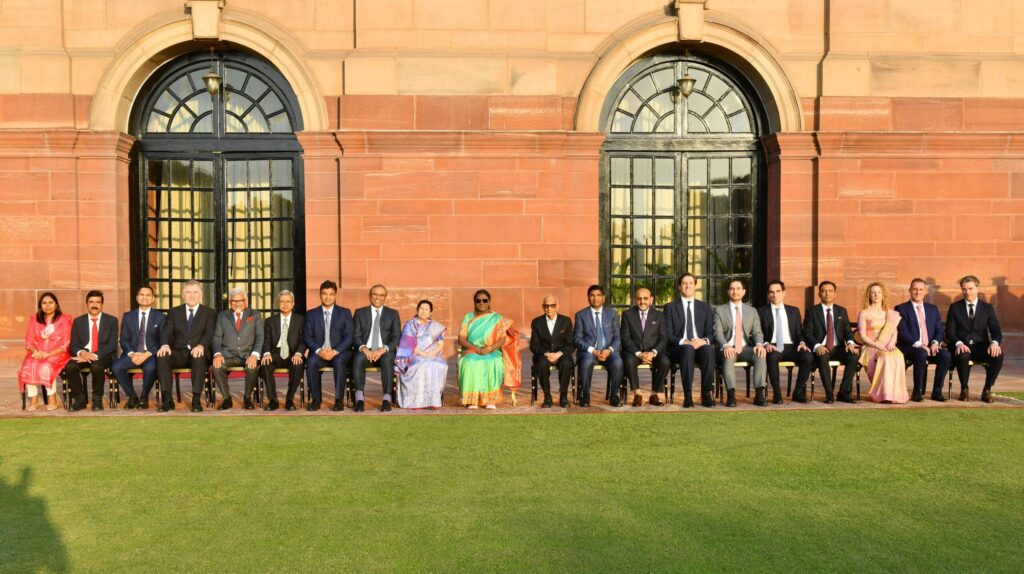
The activation of the platform is underway. In February 2026, the India Exchange in New Delhi brought together more than 190 senior leaders from 96 organisations across industry, finance, clean technology and government, and a delegation of over 20 senior leaders, led by Padma Bhushan Smt. Rajashree Birla, Chairperson, Aditya Birla Centre for Community Initiatives & Rural Development, called on the Hon’ble President of India Smt. Droupadi Murmu at Rashtrapati Bhavan, presenting a compendium of leadership voices on India-UK/Europe collaboration. In April, Xynteo convened the potential founding partners to confirm the platform’s strategic direction and shortlist priority projects; five are now in active early-stage consideration.
These priority projects translate the conviction into execution: each takes a specific provision or regulatory driver and converts it into contracted, cross-border activity. The first, the Green Metals and Critical Minerals Corridor, connects Indian low-carbon metals and minerals producers with UK and European offtake and channels European decarbonisation, MRV and processing technology into Indian facilities. The second, the Greenstock Exchange, links Indian producers of industrial byproducts such as fly ash and copper slag with European buyers whose demand is driven by EU ETS carbon pricing. The third, Cross-Border Carbon Credits, builds a pipeline of carbon credit projects under Article 6.4 of the Paris Agreement, structuring Indian decarbonisation projects for offtake by European corporate buyers. The fourth, Powering AI, pairs underutilised European brownfield sites with Indian engineering and energy technology to build data centre capacity for hyperscale demand. The fifth, the Clean Mobility Corridor, aligns automakers, utilities and policymakers across India and Europe on charging interoperability and battery lifecycle management.
For the industrial leaders conceptualising and anchoring these projects through the platform, among them Satish Pai of Hindalco and Parth Jindal of JSW Cement, the rationale for early action is clear: the frameworks are in place, and advantage will accrue to the organisations that use them first.
“The FTA gives industry the opening. By bringing together capital, technology and market demand across India, the UK and Europe, we can turn this agreement into viable projects that also deliver real social and environmental impact. That is the work industry is best placed to lead.”
Satish Pai, Managing Director, Hindalco Industries Limited
“India has the industrial scale. The UK and Europe have the capital, the technology, and the regulatory frameworks that are reshaping global supply chains. The FTA puts us in the same room commercially in a way we haven’t been before. For businesses that are serious about decarbonisation, this is the moment to stop talking about bilateral collaboration and start structuring it.”
Parth Jindal, Managing Director, JSW Cement
The coming months will turn that ambition into reality. Through a focused build phase, running to October, each project will finalise its scope, prove its business case and establish the proof points that anchor the formal launch. The destination is the London Exchange in October, where the founding partners move from in-principle engagement to signed commitments, and the pipeline opens to new partners and investors. The treaties have done what only treaties can do: establish the framework. The Green Corridor exists to enable what only business can do: build on it. The platform is open to organisations seeking to shape the green industrial partnerships these agreements make possible; we look forward to hearing from you.
“Trade agreements matter when business is ready to use them. The India-UK FTA has arrived at exactly the moment when European industrial companies are looking seriously at India, not just as a growth market, but as a technology and supply chain partner for the green transition. The companies that move early to build real partnerships under this framework will have a structural advantage.”
Michael Youtsos, Chair, Xynteo
“The scale of the green transition has always been beyond any one organisation. What changes now is that India, the UK and Europe have a real framework to act together, and a group of pioneering leaders prepared to build ahead of the market.”
Vipul Kumar, Partner and Managing Director India, Xynteo
For further information, follow us on social media (LinkedIn I Twitter), or Contact Us to find out how we can help your leaders and organisation create people and planet-positive impact.