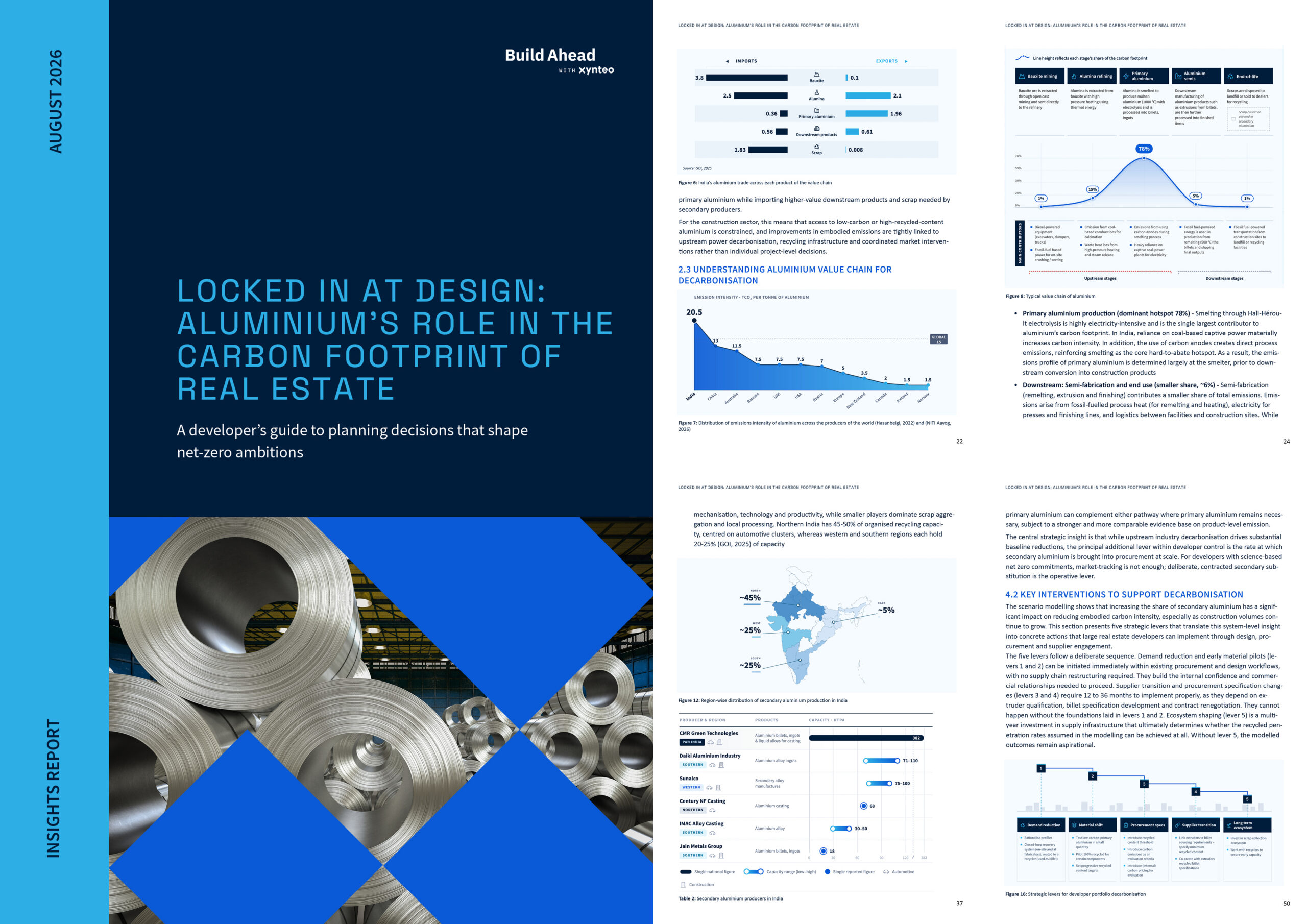
Aluminium makes up just 0.3% of a building’s material mass, yet it accounts for nearly 16% of its embodied carbon. As India’s real estate sector races to meet growing demand, this quiet imbalance is locking in decades of avoidable emissions before a single occupant moves in.
The built environment accounts for close to 37% of global CO₂e emissions; and for developers, the defining challenge is now embodied carbon: the emissions baked into materials long before a building comes to life. Aluminium sits at the centre of this challenge. It is structurally hard to abate, with more than 90% of its carbon footprint locked in far upstream, in alumina refining and smelting, at emission intensities of 20–21 tCO₂e per tonne for Indian primary aluminium.
This report argues that even though developers don’t control production, they have more leverage than they think. Through procurement choices, material specifications, and design decisions, developers can actively shape demand across the value chain and in doing so, reshape the market itself.
The findings are compelling: a secondary aluminium-led procurement strategy could cut a developer’s aluminium emission intensity by up to 91% relative to business-as-usual by 2050.
This report explores a critical gap in real estate’s decarbonisation strategy:
- The primary aluminium emissions challenge in India: Examining the built environment’s aluminium footprint, the structure of India’s aluminium industry, and where emissions concentrat across the value chain
- Developer leverage in the aluminium value chain: Mapping where developers hold influence downstream, even as emissions are created upstream, and unpacking India’s secondary aluminium ecosystem
- Key intervention for developers: Modelling decarbonisation pathways through five strategic levers – demand reduction, material shift, supplier transition, procurement specifications, and ecosystem shaping
- Implementation pathways for developers: Practical steps for engaging extruders, recyclers, and primary producers, backed by a supplier capability framework
About Lodha Foundation
Lodha Foundation, established through the generous contribution of the Lodha family, is committed to contributing meaningfully to India’s journey towards becoming a developed nation. Its work spans Education for the Gifted, Innovation through Institutions, Sustainable Urbanisation, and Community Development, with a focus on creating long-term public value and strengthening the country’s intellectual and social infrastructure.
In sustainability, the Foundation advances climate-resilient urbanisation by supporting research, partnerships, and scalable solutions in areas such as low-carbon construction, circular economy, and nature-positive urban development. It collaborates with leading universities, research institutions, policymakers, industry, and global experts to advance open-access research, build shared knowledge ecosystems, and accelerate the adoption of practical, evidence-led solutions that can shape more sustainable and resilient cities.
Suggested citation: Kaur, M., Budholia, S., Singh, L., Parihar, A. and Viswesvaran, S. (2026). Locked in at Design: Aluminium’s Role in the Carbon Footprint of Real Estate. Xynteo and Lodha Foundation.