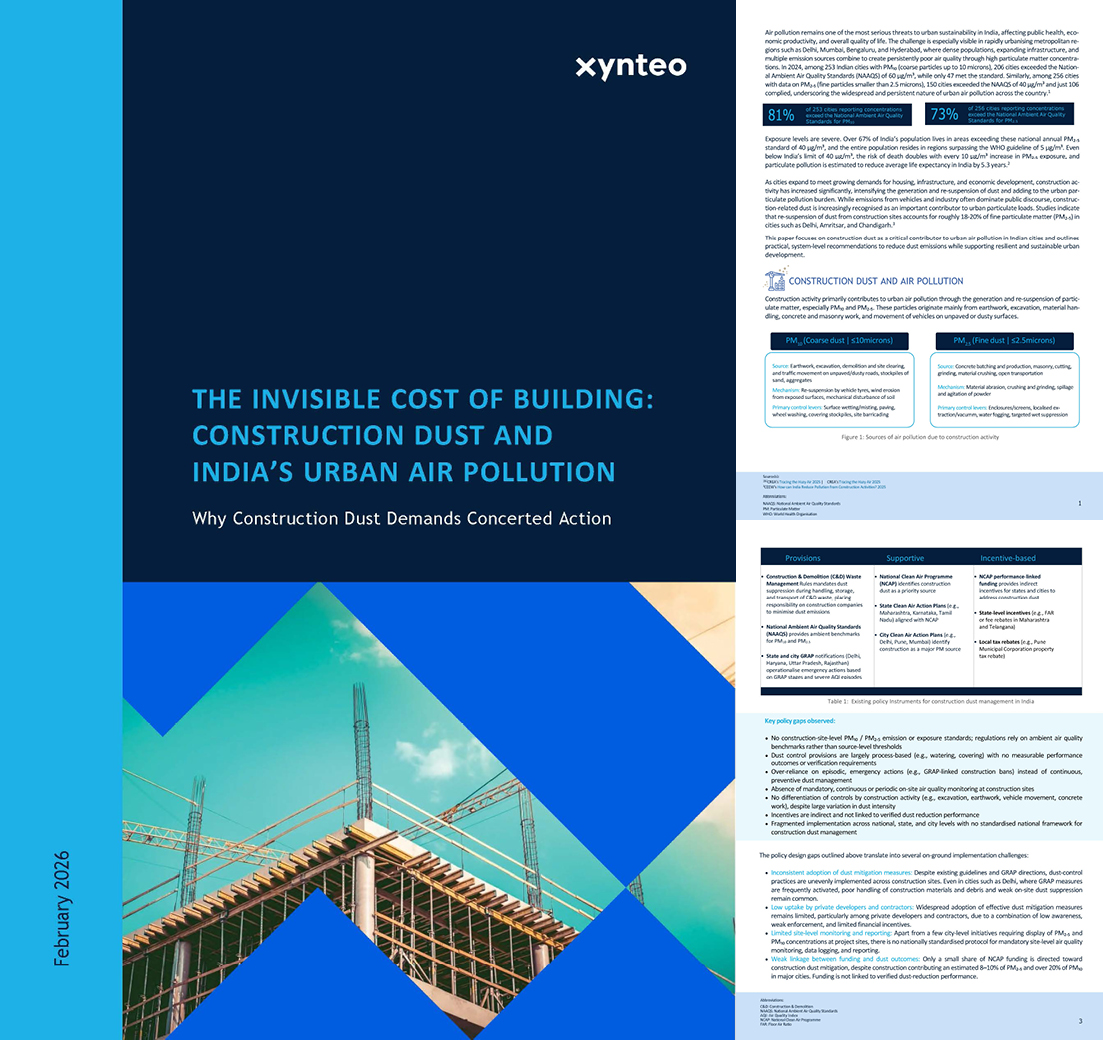
India’s cities are expanding at unprecedented speed. Yet beneath the cranes and concrete lies a hidden cost that few acknowledge: construction dust is silently eroding the health of millions.
While vehicles and industries dominate air quality conversations, construction, an engine of urban progress, emerges as a critical, yet largely unregulated contributor to particulate pollution across Indian metropolitan regions.
The numbers are stark. In 2024, more than 206 of 253 Indian cities exceeded national PM₁₀ standards, while 150 of 256 cities breached PM₂.₅ limits. Construction dust alone accounts for up to 30% of the total dust load in cities like Delhi NCR, contributing approximately 8% of annual PM₂.₅ and 21% of PM₁₀. Despite this burden, construction-related emissions remain governed by procedural guidelines rather than performance standards—a critical gap in our approach to urban air quality.
How can we unlock sustainable urban growth without sacrificing the very air we breathe? How can we align rapid infrastructure development with the urgent imperative to protect public health? This report challenges the status quo and outlines a pragmatic roadmap: transitioning from reactive, blanket restrictions to proactive, performance-driven construction dust management that rewards innovation while delivering measurable results.
This report explores a critical gap in India’s air quality framework:
- Pathways to performance: Presenting actionable recommendations for a performance-based framework anchored in site-level emission standards, real-time monitoring, and outcome-linked incentives
- The hidden burden: Understanding construction dust’s contribution to urban air pollution and its disproportionate impact on public health across metropolitan regions
- Policy-practice disconnect: Analysing why India’s existing regulatory framework—despite layers of rules and action plans—fails to drive sustained reductions in construction-related emissions
- Activity-specific insights: Examining how different construction phases (excavation, concrete work, vehicle movement) generate vastly different dust profiles, demanding differentiated control strategies
Suman Jagdev
Partner, Xynteo;
Programme Director, Build Ahead India
Shrikant Budholia
Manager, Xynteo
Milan Kaur
Manager, Xynteo