
India’s National Green Hydrogen Mission has directed significant policy attention and capital towards green hydrogen production, and the results are beginning to show. But production is only one part of what makes a hydrogen economy work. Downstream applications, such as fuel cell systems, that actually put hydrogen to work, have not attracted the same level of investment or development focus.
This imbalance matters: unless utilisation technologies mature alongside production, the sector will struggle to demonstrate real-world value, and the case for further investment across the chain will weaken. Balanced development of the full value chain is central to the sector’s growth, not incidental.
Backup power offers one of the most natural places to start building that utilisation side of the value chain. Commercial and industrial users across India generally incur a cost of ₹25–40 per kWh to run diesel generators, not because they want to, but because reliable power is non-negotiable for their operations. This is a commercially ready customer base, with an established willingness to pay and a clear problem to solve. Green hydrogen-based fuel cells can address this directly, creating an entry point that, once validated, can open pathways into broader applications across industries, data centres, and critical infrastructure.
This case study presents Hydrovert Energy, a deep-tech start-up supported by Energy Leap, as evidence of how targeted catalytic capital, technical validation, and industrial deployment support can move a start-up from promising technology to credible market traction.
The bottleneck
Despite the commercial opportunity in backup power, several structural barriers have prevented hydrogen fuel cell technologies from gaining traction in India:
- Import dependence: Early-stage developers relied almost entirely on imported components, keeping system costs high and limiting adaptability to Indian operating conditions
- Capital access gap: Conventional venture capital timelines and return expectations are misaligned with multi-year deep-tech hardware development cycles
- Market activation gap: Customers will not deploy unvalidated technology; investors will not fund without proof of deployment. Without an anchor industrial demonstration, neither side could move first
In the absence of deliberate intervention, these barriers reinforce each other, keeping promising technologies from reaching the deployment stage that would attract mainstream capital and customers.
Energy Leap’s intervention
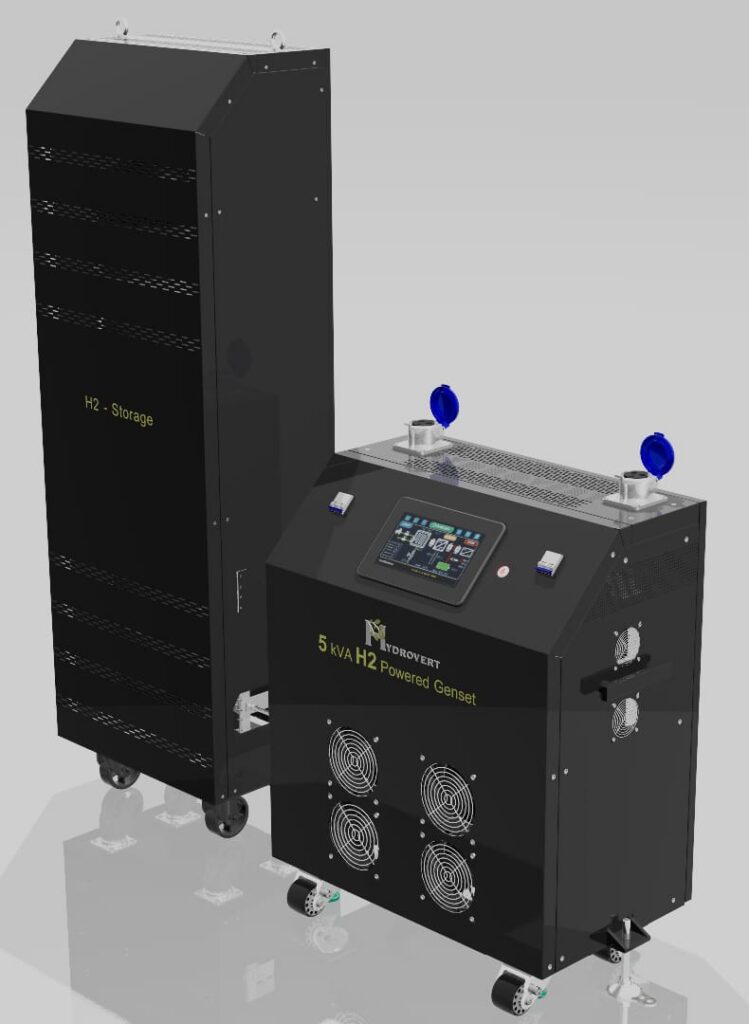
Hydrovert Energy was identified through Xynteo’s Energy Leap Innovation Challenge 1.0 in 2024 as a promising start-up developing indigenous hydrogen fuel cell powertrains for stationary backup power applications. As part of the evaluation process, Energy Leap assessed Hydrovert’s technology readiness and jointly identified the critical next step: validating a 5 kVA hydrogen fuel cell generator in a real industrial environment.
This was the specific proof point that institutional customers and equity investors needed before they could act. Hydrovert had secured initial funding, but a critical gap remained to execute the demonstration. Energy Leap stepped in with a $25,000 non-dilutive grant, precisely targeted to bridge this gap and enable Hydrovert to build, test, and deploy the solution in a live industrial setting.
Beyond the grant, Energy Leap provided technology assessment and roadmapping support, and connected the team with mentors, potential customers, and aligned investors addressing the ecosystem coordination failures that capital alone cannot solve.

From gap to proof point
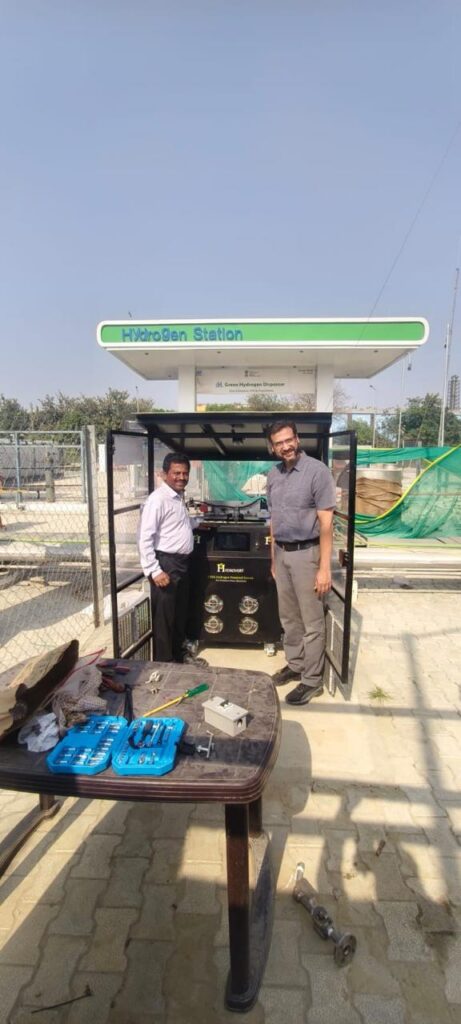
Hydrovert had a working technology, but without an industrial deployment, it had no proof point that customers or investors could act on. The successful deployment of the 5 kVA hydrogen fuel cell generator at NTPC NETRA, Greater Noida, provided that validation, confirming the technical viability of an indigenous hydrogen fuel cell system in an operational industrial setting.
The demonstration secured buy-in from a marquee industrial customer, strengthening market confidence in Hydrovert’s solution. This traction enabled the company to mobilise additional support and close the funding required to complete the demonstration project. In parallel, the validated deployment pathway helped Hydrovert facilitate its first equity investment—capital that would have been significantly harder to access without the proof point.
Energy Leap’s impact
Intermediate outcomes (emerging):
- Buy-in secured from a marquee industrial customer, strengthening broader market confidence
- Significant pipeline of customised enquiries developing across industrial, commercial, and infrastructure segments
Downstream outcomes (anticipated):
- Scalable hydrogen backup power solutions deployable across industries, data centres, and critical infrastructure
Remaining system-level gaps
Hydrovert’s progress is an early signal, not a solved problem. Several structural constraints persist across the sector that individual start-ups cannot address alone:
- Limited domestic manufacturing infrastructure for advanced hydrogen fuel cell components
- Continued investor caution around hardware-led, long-gestation technologies without further demonstration at scale
- Limited anchor customers willing to pilot hydrogen-based solutions at early commercial scale
Conclusion
Getting a hydrogen fuel cell technology from prototype to a validated industrial deployment is not straightforward – it requires capital, credible testing environments, and the right ecosystem connections. For Hydrovert, a targeted Energy Leap support bridged that gap. From it followed a key customer relationship, a closed pre-seed equity round, and a growing commercial pipeline.
For India’s green hydrogen sector to mature, production ambition must be matched by equally deliberate investment in downstream utilisation, in the technologies, deployments, and market pathways that convert hydrogen into real energy value. Programmes such as Energy Leap demonstrate that with the right intervention model, the ecosystem barriers that prevent this from happening can be systematically addressed.
For further information, follow us on social media (LinkedIn I Twitter), or Contact Us to find out how we can help your leaders and organisation create people and planet-positive impact.