Tyres sit at the intersection of industrial decarbonisation, circularity, supply chain resilience, and regulation. And in India, the challenge is now too material to ignore.
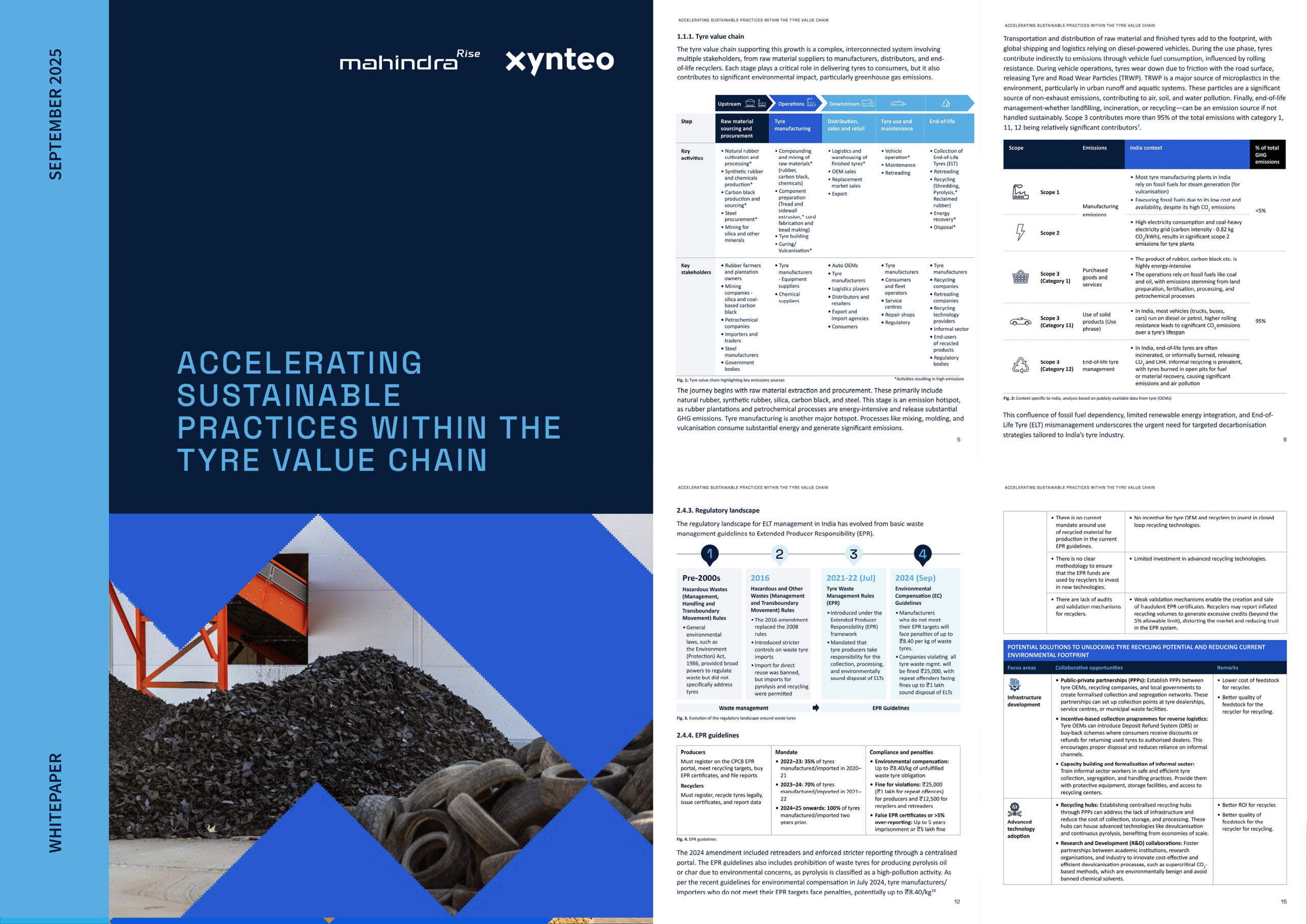
This whitepaper, developed by Mahindra Group and Xynteo, examines where the tyre value chain creates the biggest environmental impact from raw material sourcing and manufacturing to vehicle use and end-of-life tyre management. It makes the case that sustainable progress will not come from isolated action. It will come from better coordination across OEMs, recyclers, policymakers, investors, and technology providers.
With Scope 3 emissions accounting for the vast majority of the sector’s footprint, and with End-of-Life Tyre (ELT) management emerging as both an environmental and commercial priority, the report sets out a pragmatic agenda for action. The focus is clear: align climate goals with business strategy, unlock higher-value recycling pathways, and build the policy and market conditions needed to scale.
This whitepaper explores:
- Where the major emissions hotspots sit across the tyre value chain
- Why purchased goods and services, use phase emissions, and ELT management matter most
- The barriers holding back formal recycling and higher-value circular solutions in India
- How collaborative models can improve collection, recycling, standards, and market development
- What policy changes are needed to strengthen EPR implementation and support investment
- Which metrics companies and ecosystem players should track to measure real progress
The report is designed to support decision-makers across the tyre ecosystem, including tyre OEMs, automotive players, recyclers, policymakers, and investors, as they navigate the shift from fragmented interventions to more systemic, investment-ready action.
Suman Jagdev
Partner, Xynteo
Vaibhav Doshi
Associate Partner, Xynteo
Shambhavi Sharma
Consultant, Xynteo