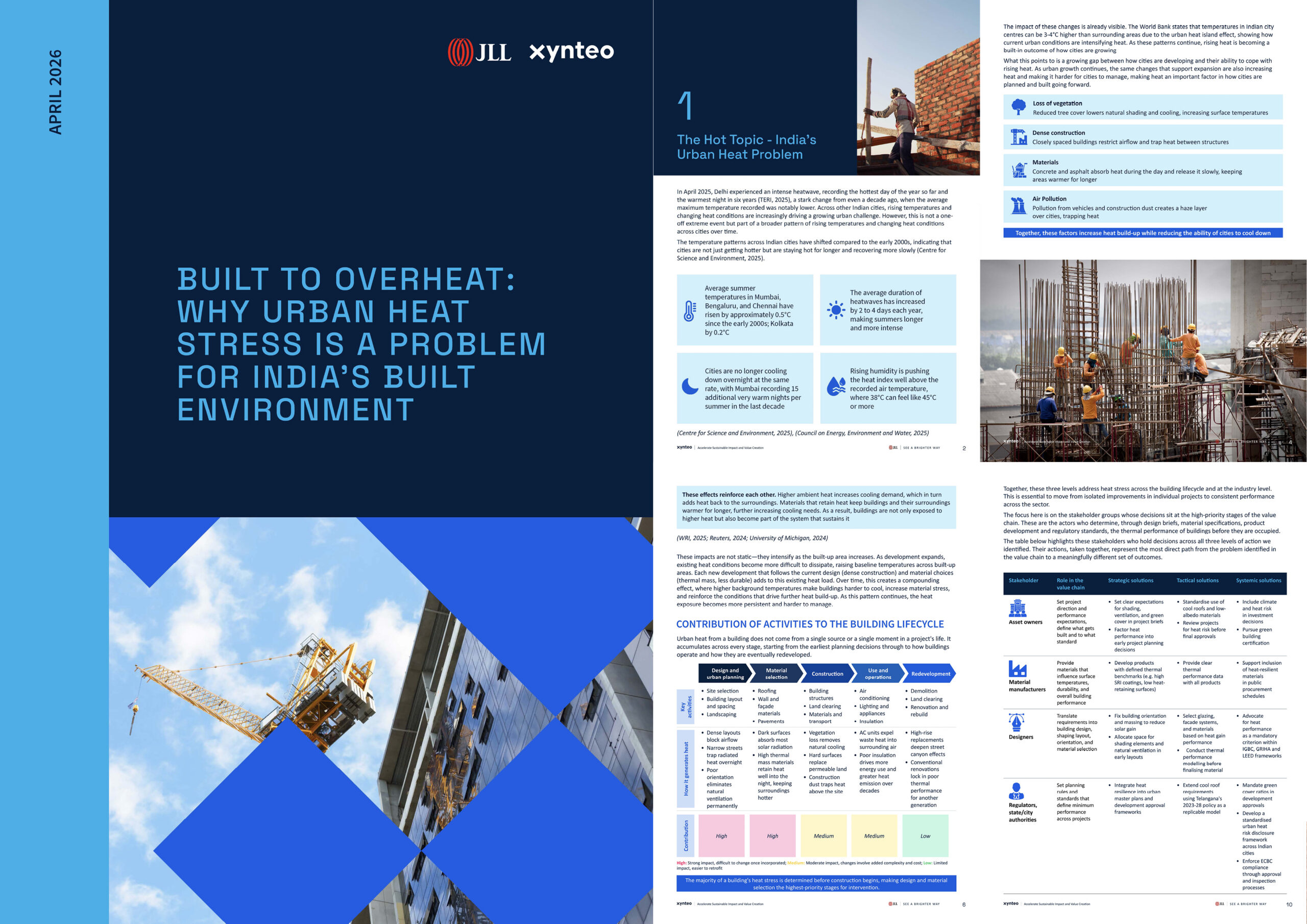
India’s cities are heating up, and they’re staying hot for longer. In April 2025, Delhi recorded its hottest day of the year and warmest night in six years, a stark change from just a decade ago. But this isn’t an isolated extreme event. It’s part of a broader pattern reshaping how Indian cities function, with temperatures rising, heatwaves lasting longer, and nights providing less relief than ever before.
As India’s urban population is projected to reach 40% in the coming years, over half of the urban infrastructure needed by 2050 is still to be built. This presents both a challenge and an opportunity. The decisions made today, on site planning, building orientation, and material selection, will determine whether India’s future cities can manage rising heat or whether they lock in decades of higher costs, lower performance, and greater risk.
The built environment is a key driver of heat stress. Urbanisation alone accounts for approximately 60% of the warming trend in Indian cities. Dense construction, heat-retaining materials, and the loss of green cover are creating urban heat islands, where city centres can be 3-4°C hotter than surrounding areas. The result is a compounding cycle: buildings absorb and trap heat, increasing cooling demand, which generates more waste heat, intensifying the problem further.
This report examines how urban heat stress is being produced through construction decisions made at every stage of the built environment value chain, and how this translates into measurable risks across building performance, occupant costs, and asset value. It provides a clear-eyed look at:
- The scale and drivers of India’s urban heat crisis – how rising temperatures, the urban heat island effect, and development patterns are creating persistent heat stress across cities
- The role of the built environment in creating and amplifying heat – how planning, design, and material choices determine thermal performance before construction even begins
- Physical and financial risks embedded in current building practices – from rising operating costs and capital expenditure to insurance pressures, asset devaluation, and stranded asset risk
- Solutions across the building lifecycle – strategic, tactical, and systemic interventions that are commercially available, proven in Indian conditions, and deployable today
- A call to action for key stakeholders – asset owners, designers, material manufacturers, and regulators—identifying where impact is highest, implementation is feasible, and ownership is clear
Umit Bhatia
Senior Director, Sustainability Consulting, Asia Pacific, JLL
Aditya Desai
Executive Director, PDS, JLL
Shrikant Budholia
Manager, Xynteo
Smriti Viswesvaran
Consultant, Xynteo