This week marks 10 years of the Paris Agreement, and we’re no longer debating if the global economy will decarbonise. The question is how fast, who leads, and who gets left behind. A decade is a blink in human history, but it’s been long enough to expose both the power and the limits of voluntary pledges, fragmented carbon markets, and uneven national ambition.
A decade after 195 nations gathered in Paris to forge a path out of the climate emergency, we find ourselves at a crossroads. The Paris Agreement has delivered measurable progress—but the gap between ambition and action remains dangerously wide. As COP30 in Belém closed and countries submitted their third round of nationally determined contributions (NDCs), one truth crystallised: 10 years in humanity’s timeline may be inconsequential, but we cannot afford complacency.
Why the progress we’ve made matters
Despite the need for review and realignment, the past decade of sustainability momentum has established critical foundations that must be preserved and built upon.
We have made real progress.
Renewables are now expected to meet 67% of global electricity demand growth by 2050, and clean energy investment has hit $2.2 trillion annually—double the spend on fossil fuels. Framework climate laws have tripled since 2015, and 83% of the global economy remains covered by net-zero targets despite geopolitical headwinds. These aren’t abstract statistics; they represent that the clean energy transition isn’t a distant aspiration, it’s the economic reality reshaping markets today.
We are also not near where we need to be.
Global emissions are still too high to keep 1.5°C “within reach” without a steep drop this decade, and 2023–2024 were among the hottest years on record. But when the Paris Agreement was adopted in 2015, the world was hurtling toward 3.7-4.8°C of warming by 2100. Today, if countries deliver on current commitments, that trajectory has shifted to 2.3-2.5°C—still catastrophic, but demonstrably better. This isn’t luck, though; it’s the result of policy frameworks, technological breakthroughs, and market forces aligning in ways few predicted.
The point now is not to declare success or failure, but to recalibrate. Ten years in, we have enough evidence to know what is working, what isn’t, and what must change before 2030.
The implementation of carbon markets
Carbon markets were always billed as one of the Paris Agreement’s big levers for efficiency and scale. One of the agreement’s most complex mechanisms—Article 6—is finally moving from negotiation to implementation. After nearly a decade of technical wrangling, COP29 in Baku established operational standards for both bilateral carbon trading (Article 6.2) and the centralised Paris Agreement Crediting Mechanism (Article 6.4).
While the promise is significant, it allows emission reductions to occur where they’re most cost-effective while channelling finance to developing nations. Analysts estimate that the EU alone will purchase at least €50 billion in carbon credits in the 2030s to meet its targets, potentially catalysing massive investment in climate projects across the Global South.
But the devil is in the details. Concerns about double-counting, additionality, and environmental integrity persist. That means robust monitoring, transparent accounting, and consequences for non-compliance.
The UK leads on national pledges, and India balances development
The Paris Agreement rests on national pledges, NDCs, that are meant to ratchet every five years. Ahead of COP30, 122 countries had submitted new or updated NDCs, a “decisive step” in the words of the COP30 Presidency, but collectively still insufficient for 1.5°C, according to the COP30 Brazil Presidency.
The UK’s updated NDC demonstrates what ambitious climate action looks like from a developed economy. Committing to 81% emissions reductions from 1990 levels by 2035, the UK has set a trajectory that aligns with net-zero by 2050 while maintaining economic growth—having already cut emissions 53% while growing GDP by 82% since 1990.
The UK’s renewables now contribute more electricity than fossil fuels for the first time, demonstrating that decarbonisation and prosperity can advance in tandem.
India’s approach reflects different realities. As the world’s third-largest emitter, India has committed to reducing the emissions intensity of GDP by 45% below 2005 levels by 2030, with 50% of installed electricity capacity from non-fossil sources. It’s an intensity target, not an absolute reduction—allowing emissions to rise as the economy grows while becoming cleaner per unit of GDP.
Critics argue this isn’t enough, but context matters. India explicitly states it needs $2.5 trillion in climate finance to achieve its 2030 goals, with international support covering the gap beyond domestic resources. This underscores a fundamental tension: developing nations’ ambitions are directly tied to developed nations’ financial delivery.
COP30 and the upcoming decade of implementation over aspiration
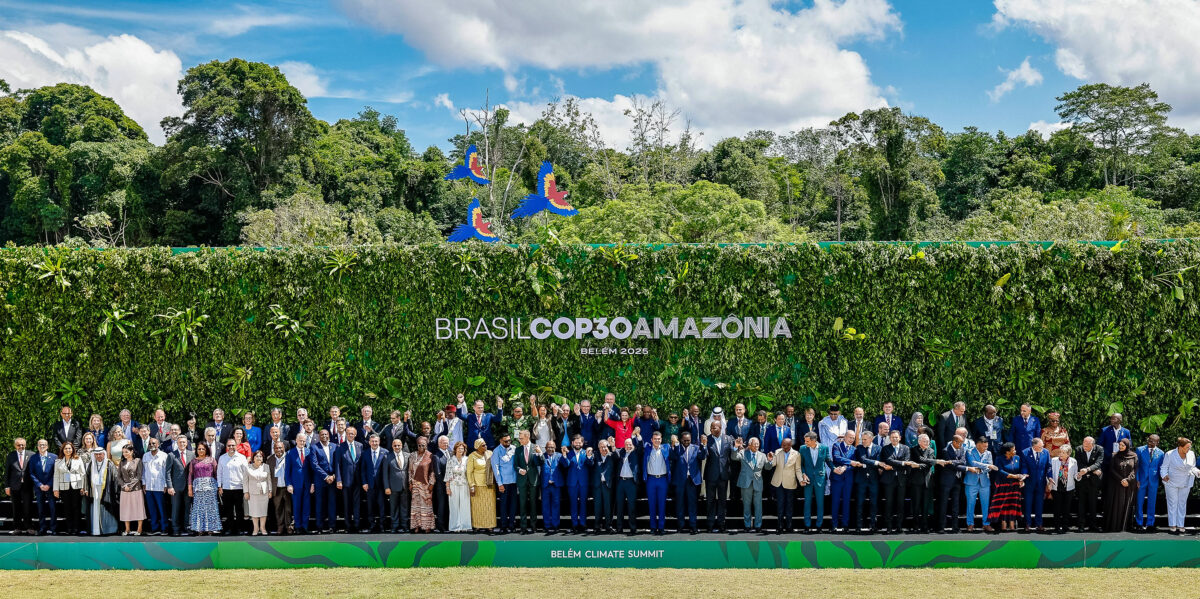
COP30 in Belém was always going to be a symbolic moment: 10 years after Paris, hosted in the Amazon. However, it delivered measured progress—not a breakthrough: a commitment to triple adaptation finance by 2035, a just transition mechanism, and the Global Implementation Accelerator to help countries deliver on their NDCs.
While no formal roadmap to transition away from fossil fuels made it into the final text despite backing from over 80 countries, Brazil’s presidency proposed voluntary roadmaps outside the formal UN process.
The adaptation finance commitment—$120 billion annually by 2035—is progress, but it’s less and later than climate-vulnerable nations need. To be sure, the Baku-to-Belém Roadmap to $1.3 trillion annually by 2035 does provide a framework. This is how climate politics works now: formal UN decisions set the floor; voluntary coalitions and national policies set the pace.
The next 10 years will decide the story
In human terms, 10 years is roughly the time it takes a child to go from starting primary school to secondary. In climate terms, it’s the core of the carbon budget decade. The UN Secretary-General has acknowledged that overshooting 1.5°C—at least temporarily—is now inevitable. That’s not a reason to give up; it’s a call to fight harder to limit overshoot and bring temperatures back down.
That means:
- Early action is vastly cheaper and more effective than late action. Every year of delay locks in assets that will either continue emitting or become stranded.
- “We’ll catch up later” is not a strategy. It’s a decision to absorb higher physical risks, steeper eventual policy shocks, and more costly transitions for businesses and households.
The next 10 years will not be smooth. We will roll with policy reversals, technological surprises, and geopolitical shocks. But we are still early enough in this transition for missteps to be corrected, and for ambition to be ratcheted rather than quietly retired.
Countries must strengthen their 2035 NDCs, deliver on finance commitments, and accelerate implementation. The Global Implementation Accelerator and Belém Mission to 1.5°C launched at COP30 provide mechanisms to drive this—but only if backed by political will and resources.
Carbon markets must prove they can deliver real, additional emissions reductions without gaming the system. Developed nations must follow through on finance—not just pledges, but actual dollars flowing to adaptation, mitigation, and loss and damage. And we need honest conversations about fossil fuels: the science is unequivocal that reaching net-zero requires phasing them out.
The Paris Agreement has bent the curve of global warming. That’s real. But bending isn’t enough—we need to break it. Ten years in, we’ve proven that international cooperation can drive change. Now we need to prove we can move fast enough to matter.
Get in touch with Amy Marshall or Sam Preece to discuss how Xynteo can help your organisation:
For further information, follow us on social media (LinkedIn I Twitter), or Contact Us to find out how we can help your leaders and organisation create people and planet-positive impact.