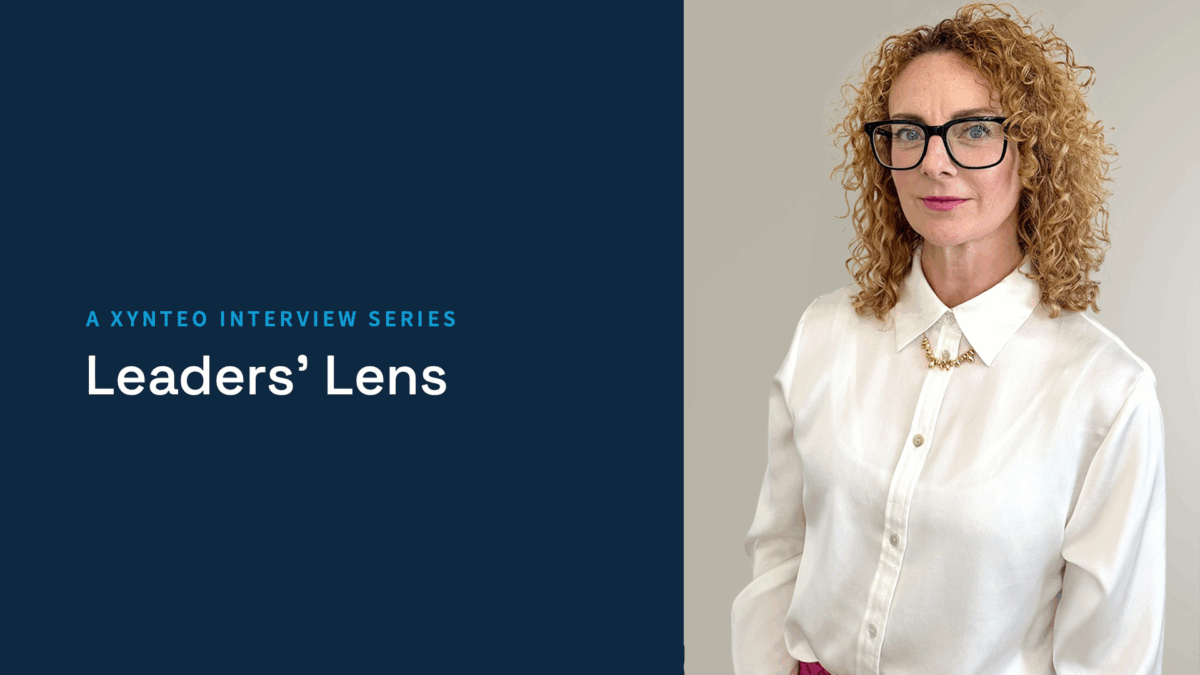
Meet Amy Marshall, Xynteo’s Partner and Managing Director Europe, a strategic leader whose 25-year career has been defined by driving transformational change across energy, clean mobility, and telecommunications.
From pioneering smart metering deployment in the UK to leading growth strategies in energy retail and electric vehicle sectors, Amy has consistently operated at the forefront of decarbonisation and sustainable impact. In this conversation, Amy reflects on the pivotal moments that shaped her journey—from recognising the powerful role technology plays in decarbonising our energy systems to championing consumer participation as essential to real progress. We also discover what drew her to Xynteo’s dynamic environment after such an accomplished career, why she believes outcomes trump outputs every time, and where she sees the most compelling opportunities for organisations genuinely committed to creating sustainable value in the years ahead.
You’ve had a remarkable 25-year career, leading significant transformations in energy, clean mobility, and telecommunications. What pivotal experiences from your journey, particularly before joining Xynteo, most profoundly shaped your approach to driving sustainable impact today?
Amy: Honestly, I hadn’t stopped to think about it being a quarter of a century until you framed it that way—so that was a bit of a moment in itself. But looking back, there have been several pivotal experiences that shaped how I operate.
I often say I got into energy and sustainability by accident, but I stayed because it became deeply value- and purpose-driven for me. I initially entered the energy sector through the deployment of smart meters in the UK market. At first, it was the technology that intrigued me—the idea of using technology, making more efficient use of assets and more effective capital investments in our energy system. But when I realised the critical role technology could play in decarbonising the energy system, that’s when it truly clicked. Understanding that this work, even in small ways, contributes to decarbonising large swathes of the economy was transformational.
Another pivotal realisation—one that’s been consistent from my smart metering days through to my work in energy retail and now in clean mobility—is the importance of consumers as active participants in decarbonisation. This isn’t about consumers being passive recipients of systemic change. It’s about giving people agency and control over how they use energy, ensuring their voices are heard, and designing experiences with them in mind. Whether someone is buying an electric vehicle or making choices about their energy use, if we don’t get the consumer experience right, and if we don’t get super clear about the impact of our choices, then we slow progress. This principle applies across so many areas of life and the choices we make from what we eat, how we power our lives, and how we move.
I’ve also learnt that what really drives me is looking to the future, and operating in emerging areas—and working with and for growth businesses. But the key insight here is that growth is a mindset, not just a state of being. Over the past few years, we’ve seen a boom in sustainability advisory, followed by some backing off from investors, organisations, and governments. But that doesn’t mean we should retreat from our ambition. It means we need to find different, innovative ways to deliver on that ambition. How you think about growth matters enormously.
Finally, on a personal level, some of my biggest professional breakthroughs have come through working with coaches. The right coach, at the right time, offering an outside-in perspective on your motivations can be hugely transformational. That’s certainly been true for me, and I’d strongly encourage anyone thinking about their career development to seek out that kind of support.
Having been at Xynteo for a year, what motivated you to join at this stage in your career, and what has been the most significant learning or observation you’ve made about Xynteo’s unique model in that time?
Amy: First, the fact that we’re a business grounded in the belief that we need to change systems in order to affect the outcomes we want—that systemic change view rather than a transactional view is both intellectually quite interesting and very necessary if we’re looking to affect exceptionally complex change across really significant parts of the economy. I think it’s quite unusual. Over the last year, we’ve landed on what I believe is quite a unique blend—combining that systems perspective and the running and forming of coalitions, which has been part of Xynteo’s pedigree for a very long time, with how you then make it happen through more traditional advisory services. Neither side of that coin is necessarily unique on its own, but I think in combination we’ve ended up somewhere quite different—the collective view driving the individual corporate change.
Again, back to personal motivations—the fact that we’re a sustainability impact pureplay was probably the number one most important thing to me. That’s where I want to put my energy. That’s where our pedigree has been, whether that’s played out in the energy transition, decarbonisation of transport, or plastic circularity. These are the subjects that matter most, and I think it’s fabulous that we’ve had that as part of our history since the day we were founded. And thirdly, we’re a growth business, which, as I just said, is always good fun.
What have I learnt? Well, perhaps flippantly, I’ve learnt that some of the back-office infrastructure in big organisations that I used to complain about is actually quite useful. More seriously, I’ve learnt that being agile in a small organisation means stretching all the way up and all the way down. The price of agility and flexibility is that sometimes you have to both go very broad and very deep on lots of things to make stuff happen.
Growth is a mindset, not just a state of being. Over the past few years, we’ve seen a boom in sustainability advisory, followed by some backing off from investors, organisations, and governments. But that doesn’t mean we should retreat—it means we need to find different, innovative ways to deliver on that ambition.
From your perspective as Partner and Managing Director Europe, what do you identify as the most pressing challenges and the most exciting opportunities for global organisations striving to achieve sustainable impact and value creation right now?
Amy: I think we come back a little bit to the point I was making about the growth mindset. The headwinds we see across all those big sustainability thematics are probably twofold. So firstly, a softening of sentiments on sustainability and climate impacts on the public stage. By which I mean backing off targets, pushing out deadlines, et cetera. I think that’s clearly been a bit of a headwind. Some of these big, broad sustainability thematics, like energy transition, are industries in development. Therefore, the valley of death that you often see as you’re going through big technological changes applies to these sectors as well. And related to that, we’ve seen over the last couple of years—probably more markedly—some of the capital flows that were around the area that we focus on and that others start to slow as well. It’s important to remember that what feels like strong headwinds has only been around for a couple of years. And suppose you believe that we’re on this journey for a couple of decades, which I absolutely do. In that case, you find exciting opportunities in industries where the transition is genuinely underway—energy, transport, food systems. These are areas where real change is happening, and organisations that can navigate the complexity and bring stakeholders together to create systemic change will be the ones that thrive. That’s where I see the most exciting work happening right now.
Xynteo’s mission is to “accelerate sustainable impact and value creation”. How do you personally interpret and operationalise this mission in your work with clients, especially given your expertise in investment advisory and operational transformation?
Amy: We chose sustainable impact and value creation as our mission quite deliberately – we apply the lens of “what is the impact of this work”, “why do we believe it’s sustainable”, “what value is being created” to the project we do and the work we pursue. That’s why we look at plastic circularity, industrial decarbonisation, energy transition, et cetera. So that’s one—it’s by business design.
In terms of how we think about sustainable impact and value creation—one of the things we do that’s a little unusual, or certainly different, is that when we write a strategy, we don’t leave it on the table. When we do a fundraise, we don’t write a report and then hand it over. We actively think at the beginning of a strategy process or an investment advisory process about how that piece of advice can be taken through into the operation of the business. So, if you’re buying a company, the next thing you might want to do with it to increase value and increase the impact it has—and we can help you with that as well.
We try to think holistically, systemically, and in the long term about the advice we’re giving. Back to that whole point around systemic change—it’s incredibly rewarding for all of us as people who are in this market and passionate about the subject matter. But I think it also delivers much better value for clients. To be frank, we should be held to account for thinking forward through the question being asked—into what we can do next and what we can do more. That’s how you deliver more value, in my view.
Looking ahead, what emerging trends or systemic shifts do you anticipate will redefine these sectors in the next 3-5 years, and how is Xynteo uniquely positioned to guide clients through them?
Amy: I’ll highlight three things, bearing in mind these are very high-level and will be clearly very nuanced depending on which particular area we’re looking at.
First, I think there’s this drive for outcomes over inputs and execution over ideas. That’s one of the things we’re already seeing, and I think it’ll only continue to accelerate. We’re seeing our own organisation and lots of other organisations really having to get their heads around how you execute rather than just drive thought leadership or policy papers or slightly less direct outputs. I think we’re very well placed because we’re also on that journey—we’ve been on one side, and we’ve moved to the other. We have a lot of people who’ve done a lot of execution in their own careers, so we’ve got the right people to address that. We’ve seen it, we’ve addressed it, and we’re working with it.
The second thing I’ve observed, not only in my own market areas but in conversations with other members of the Xynteo team who focus on different sectors, is the prevalence and need for shared models and shared infrastructure. That can be anything from co-investment across the private sector or public and private sector in a recycling facility, to shared investment or shared ownership or shared usage of EV charging stations. It can be the kind of models we saw happen in the mobile telephony industry a couple of decades ago, where instead of competing, all the networks decided to share masts. So shared ownership and shared models are something we’re seeing come forward increasingly, and we’re very well placed to address that because of our pedigree in coalitions—working with organisations that would otherwise compete, working cross-sector, working in that collective way. It’s been part of our DNA..
And then the third, which you can’t not say, is the impact of tech—technology-enabled anything. And I don’t only mean AI. I mean the power of technology to accelerate change. Again, back in one of my stomping grounds around green mobility, one of the transitions many of our clients have had to go through mentally as they’ve switched from petrol vehicles to electric vehicles is that it’s not just changing the vehicle—it’s changing the way you run a fleet, the way you operate a vehicle, the way you interact with the charging or fuelling infrastructure. Many of those things require you to get your head around technology that simply didn’t exist before. That’s one example, but obviously, AI also changes everything. Though I’m not the first person to say that!
Considering your extensive experience in forging partnerships and driving market entries, what role do you believe cross-sector collaboration and innovative strategies will play in unlocking the next wave of sustainable growth for businesses?
Amy: Going all the way back to one of the things I found interesting about Xynteo’s model —this concept that you have to bring diversity of thinking to how we address these really complex and sticky challenges—that to get better answers, you have to have several things. First, diversity of thought. But diverse thought is only helpful to the extent that you can access it, share it, and genuinely use it to bring the collective forward. So, it’s not enough on its own. You need the ability and the mechanism to cross-fertilise ideas across those diverse perspectives.
And then the bit that I often say is the least sexy but possibly the most useful in this context is that you actually have to have a structured methodology and a structured approach to taking this incredibly smart, diverse thought, making it cross-fertilise, and then taking the output of that into something you can execute. That’s where the slightly unsexy consulting methodology point comes in. Because if we really want to do something with it, you must be able to blueprint it, productise it, and do it efficiently. All of those below-the-line things are, I think, super important.
And I think that’s where Xynteo comes in. We have the pedigree and the big thinking. We’ve got the ability to help cross-fertilise—our history over the last 20 years tells us that. And we have the methodology to make it land.
Get in touch with Amy to discuss how Xynteo can help your organisation:
Stay up to date with our latest interviews by following us on social media (LinkedIn I Twitter), or Contact Us to find out how we can help your leaders and organisation create people and planet-positive impact.