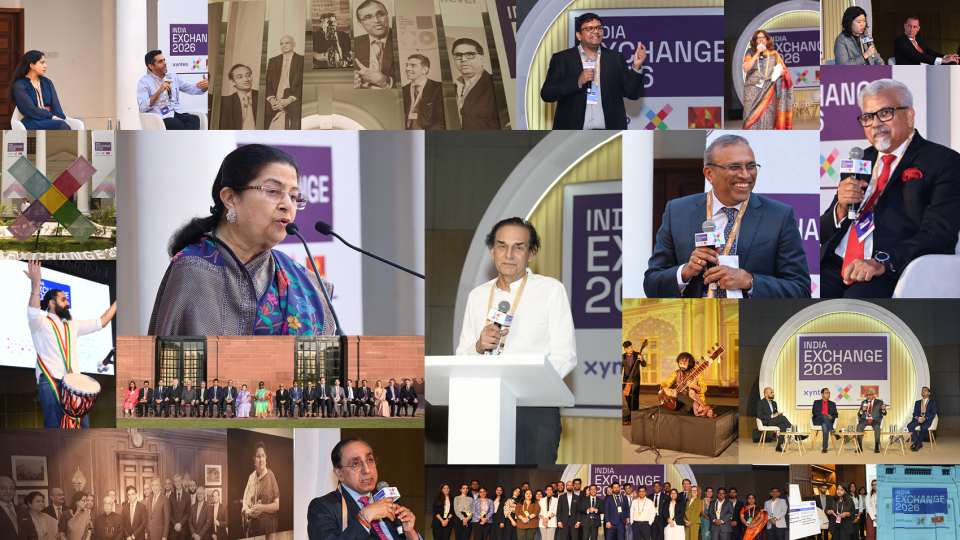
The India-UK and India-EU FTAs have set the political stage and created the architecture for deeper collaboration. The next step is turning these frameworks into real flows of capital, technology, talent, and innovation. That is exactly what the India-UK/Europe Green Corridor is designed to do. India Exchange 2026 marked an important step in bringing that vision to life.
A verse in the Bhagavad Gita has stayed with me for a long time. It speaks of the responsibility to act with integrity, discipline, and conviction—without being paralysed by uncertainty.
“karmaṇy-evādhikāras te mā phaleṣu kadācanamā karma-phala-hetur bhūr mā te saṅgo ’stv akarmaṇi”
I opened the India Exchange 2026 with those words, and over the two days that followed, I watched senior leaders live them out.
The backdrop was significant: the India-EU Free Trade Agreement had just moved decisively into focus, and the India–UK FTA was gathering momentum. As European Commission President Ursula von der Leyen put it, this was about bringing together “Indian skills, services and scale with the UK/Europe’s technology, capital and innovation.” In one sentence, she described the design of the India-UK/Europe Green Corridor.
But design is not delivery. And that gap—between the architecture of ambition and the reality of execution—was exactly what India Exchange 2026 set out to close. Three messages emerged with clarity.
Governments enable, industry implements. Together, they transform.
Free Trade Agreements are thousands of pages of painstakingly negotiated commitments. They are a signal of intent, of trust, of political will. But a signal is not a system. That distinction matters. Governments are the enablers: they set the policy architecture, open the doors, and reduce the friction. But the outcomes—the projects, the partnerships, the actual flows of capital, technology, and talent—are built by industry. Without both roles playing in concert, the potential unlocked by these agreements remains just that: potential.
What India Exchange 2026 demonstrated is what happens when the two roles align. The political architecture is in place. The question now is whether industry is ready to act as the architect of what comes next to layer a real operating structure on top of the frameworks, and convert agreements into action. The Green Corridor is that structure. It is a construction project, and industry is the builder.
On the eve of the Exchange, a delegation of senior leaders spanning metals and mining, energy, clean mobility, circularity, finance, and clean technology—from India, the UK, and Europe—met the Hon’ble President of India, Smt. Droupadi Murmu, at Rashtrapati Bhavan. Led by Padma Bhushan Smt. Rajashree Birla, the delegation—which included senior leaders from Xynteo, Aditya Birla Group, Hindalco Industries, UltraTech, Thermax, Volvo Group, Bayer CropScience, Energy Efficiency Services Limited, Leon Capital, and Origination Foundation—briefed the President on the intent and ambition of India Exchange 2026, and presented a compendium of actionable pathways to operationalise the Green Corridor: moving beyond dialogue to lighthouse projects, cross-border alliances, and commercially viable collaborations. It was a moment that captured the essence of this first message—government as enabler, industry as implementer, and the corridor as the shared destination.
Complementary capabilities must flow—capital, technology, talent, and innovation.
The complementarity between India and the UK/Europe is real and well-documented: technology and capital on one side, market scale and talent on the other. But complementarity alone does not create projects. It creates possibility. Turning possibilities into projects requires architecture.
The rules of the game for deploying capital don’t change overnight; trillions of dollars sit outside India. The question is whether they are flowing to the right places, in the right form, at the right time. Returnable capital deployed to de-risk nascent sectors, close ecosystem gaps, and create the market conditions that allow private capital to follow at scale.
But capital is only one dimension. 99.45% of new electricity generation capacity coming online this year is renewable—not because it is the right thing to do, but because it is the cheapest. The economics of transition are winning. What is needed now is the architecture to channel that momentum across all its dimensions: bankable pipelines, regulatory certainty, technology transfer mechanisms, and the talent pathways that allow innovation to move between geographies.
The Green Corridor aims to become that architecture—a structured, credible pathway for the full range of complementary capabilities to flow between the UK/Europe and India’s most critical transition sectors.
Systemic transformation demands purpose and a business case.
Partnership is the new leadership. It is a statement that has been true for a long time and is now simply undeniable. This philosophy is core to how we think at Xynteo. Systemic transformation does not happen through individual effort, however well-resourced. It happens when purpose and business case align and when that alignment is pursued collectively.
Purpose is what drives individuals, but business value is what drives change at scale. The two are not in tension. They are the same argument, made differently to different audiences. The leaders who are winning are those who have stopped choosing between them and started building systems that create value across the entire stakeholder ecosystem.
We designed India Exchange 2026 around three objectives: unlock cross-border growth, incubate lighthouse projects, and shape a private-sector narrative that turns FTA frameworks into bankable outcomes. The conversations over those two days gave us the raw material for all three.
The next step is London. The Green Corridor is being built—one partnership, one project, one committed leader at a time. No ambition is too large to be pursued collectively.
More on Xynteo ExchangeThe India Exchange 2026, presented by Aditya Birla Group in collaboration with Xynteo, was held on 24-25 February in New Delhi, as part of building the India–UK/Europe Green Corridor. We are immensely grateful to our Strategic Partners, Mahindra Group Hindustan Unilever, Marico Innovation Foundation, Khaitan & Co, and JSW Cement, for their vision and support in making this possible.
For further information, follow us on social media (LinkedIn I Twitter), or Contact Us to find out how we can help your leaders and organisation create people and planet-positive impact.